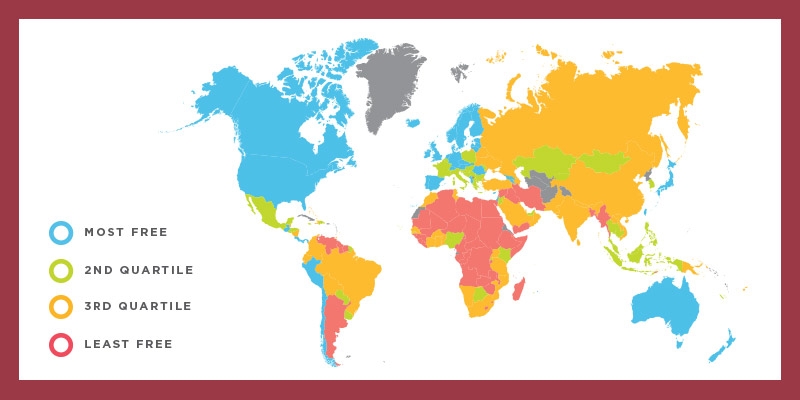
Economic freedom plays a pivotal role in assessing a nation’s prosperity within the world of economics. Economists evaluate it through indices measuring aspects such as trade freedom, tax burden, and judicial effectiveness. Consequently, these indices offer a comprehensive understanding of a country’s economic landscape and influence policy decisions. In this essay, we will delve into the history of economic freedom indexes. Moreover, we will explore the Heritage Foundation’s Index of Economic Freedom, examine its impact on nations, and discuss its limitations.
Furthermore, we will touch upon the link between political freedom and economic growth, the importance of a free enterprise system, and introduce the Human Freedom Index. To conclude, we will highlight the significance of economic freedom in today’s global landscape.
The history of economic freedom
The history of economic freedom indexes reveals their roots in New Institutional Economics. Scholars like Adam Smith, widely regarded as the father of economics, emphasized the significance of free trade and private property rights in fostering economic growth and general prosperity. In the 20th century, economists such as Milton Friedman and Friedrich Hayek underscored the pivotal role of market-driven exchange and entrepreneurial activity in elevating living standards.
Quantifying economic freedom as a measurable concept allowed economists to conduct empirical studies. This, in turn, facilitated testing the relationship between institutions and economic growth, thereby challenging existing theories of economic development.
Economists assess economic freedom based on various factors, including property rights, tax burden, business freedom, and trade freedom. Subsequently, they compute composite scores for each country, enabling them to rank nations based on their levels of economic freedom.
The Heritage Foundation’s Index of Economic Freedom is renowned for assessing countries based on 12 essential factors. These factors encompass property rights, judicial effectiveness, and fiscal health. The index has unveiled a strong correlation between economic freedom and citizens’ income levels, GDP growth, and the prevalence of the rule of law.
Investors can utilize the Heritage Foundation’s Index of Economic Freedom website. This resource features a dynamic heat map, offering valuable insights into changes in economic freedom worldwide. In particular, investors interested in emerging markets can benefit from this tool. Notably, negative changes in the index signal the need to reduce exposure to declining nations.
The index of economic freedom
is crucial for evaluating policy changes in emerging markets. For example, the BRICS nations (Brazil, Russia, India, China, and South Africa) are striving to enhance economic cooperation. In 2023, these nations welcomed additional members, further demonstrating the impact of economic freedom on global politics and economics.
However, it’s crucial to acknowledge the limitations of economic freedom indexes. Divergent definitions of economic freedom among economists create challenges. For instance, some consider the absence of minimum wage laws as labor freedom, while others see it as a restriction of worker freedom.
Nevertheless, despite these disagreements, economic freedom indexes have significantly influenced economic development and public policy. They have guided nations toward areas of improvement, as studies have shown. For example, while a correlation exists between political freedom and economic growth, establishing causation is intricate. Transitioning to democratic governance has led to a 20% average gain in economic prosperity over 25 years. This can be attributed to the removal of inhibiting factors and investments in human capital.
Economic freedom is a fundamental element of a free enterprise system, where minimal government interference enables individuals to engage in business, work, and enter voluntary contracts. In addition to the economic freedom index, the Cato Institute and the Fraser Institute jointly publish the Human Freedom Index, which evaluates personal, civil, and economic freedoms. Furthermore, it extends its assessment to non-economic areas like religion and association in civil society.
In conclusion, the index of economic freedom is a valuable metric for comparing different economic systems. While the Heritage Foundation’s index is widely used, several institutions offer their versions. Each aims to quantify the impact of regulations, taxation, and government intervention on free enterprise and market activity. In today’s interconnected global economy, understanding and promoting economic freedom are paramount for the prosperity and well-being of nations.